Septimus Warren Smith’s nervous breakdown
Mrs DallowaySeptimus Warren Smith’s nervous breakdown is the delayed consequence of war trauma and a crisis of perception that exposes the distance between a sufferer’s experience and the explanations offered by those around him. After returning from the war, he cannot feel as he believes he ought to; fear, isolation, and visions grow into a private world that his doctors describe in clinical terms and his wife struggles to understand. His breakdown is both a personal affliction and a conflict over who has the authority to interpret it.
Background and the delayed effects of war
Before the war, Septimus was a promising young clerk at Sibleys and Arrowsmiths. Mr. Brewer, the managing clerk, thought highly of his abilities, expected that he might eventually occupy a senior position, and worried about his health. Septimus was among the first to volunteer for military service. His idealized motive was to save an England made up in his imagination of Shakespeare and Isabel Pole, whom he had seen in a green dress. The war abruptly changed the quiet young man Brewer had known.
Septimus served in France and advanced in rank. When his friend Evans was killed in Italy shortly before the Armistice, he congratulated himself on feeling little emotion. He took that absence of grief for composure and believed the war had taught him something sublime. He survived the final shelling and expected to survive the rest of life as well. But after the fighting ended, fear arrived in sudden episodes, especially in the evening. In Milan, the household where Italian women made hats offered him a refuge: their work and company reassured him, though he could not remain there all night. At times he woke with the sense that the bed was falling and that he was falling with it. His engagement to Lucrezia, one of the hat-makers, came during a period of panic about his inability to feel. The self-control he had mistaken for health thus preceded a more visible collapse.
A changed relation to the world
In London, ordinary public scenes acquire an alarming significance for Septimus. At about thirty, he appears pale and apprehensive to strangers. When traffic stops beside a shop window and people turn their attention to a motor car, he fears that he is blocking the way for some purpose and imagines that the world is poised to burst into flames. The surrounding crowd’s attention becomes, in his perception, a threatening convergence on him. His sense of being watched and singled out is not shared by the people nearby, but it governs how he experiences the scene.
Other moments transform the same heightened attention into wonder. In Regent’s Park, Lucrezia urges him to look at smoke writing in the sky. Septimus reads it as a signal addressed to him, an inexhaustible gift of beauty; Lucrezia learns from a nursemaid that the smoke is an advertisement for toffee. The contrast is revealing: what feels to Septimus like a communication of cosmic importance has an ordinary explanation for others. His perceptions are not simply blank or meaningless to him. They make the world intensely communicative, but that communication isolates him because those around him cannot confirm its significance.
His convictions also take on a moral and universal scale. He believes that trees are alive, that there is no crime, and that love is universal, and he feels compelled to convey these truths to the Prime Minister and Cabinet. At the same time, the idea that his marriage is over briefly brings him relief and a sense of freedom; he imagines himself alone, summoned to understand what civilization has not yet revealed. The swing between revelation and isolation makes his experience difficult to translate into the terms other people use. When a dog’s approach terrifies him because he fears it may turn into a man, the ordinary world again appears to be undergoing an alarming transformation.
Symptoms, marriage, and failed recognition
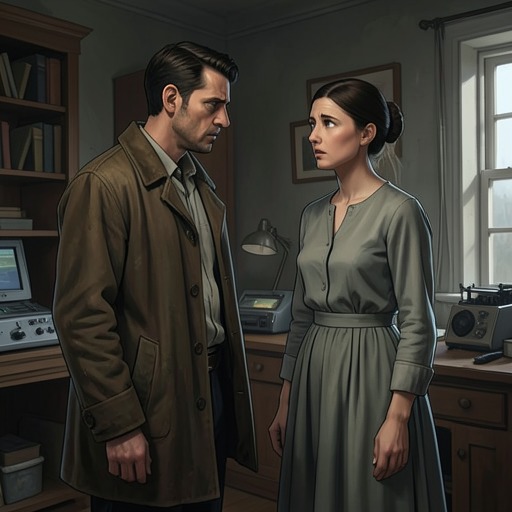
The breakdown affects Lucrezia as well as Septimus. She watches him stare at the sky, mutter, and clasp his hands, while Dr. Holmes has told her that nothing is seriously wrong with him. Septimus misreads her missing wedding ring as a sign that she has left him, although she explains that she has put it away because her hand has grown thin. The small object becomes, in his interpretation, proof that their marriage has ended. His conviction that he is alone is therefore bound to a painful misreading of the person trying to remain beside him.
Lucrezia also witnesses a happier interval that does not resolve the difficulty. She sees Septimus smiling and knows that, at that moment, he is happy. Yet his abrupt changes, long silences, laughter, and demands that she write down his discoveries make the marriage strange and hard for her to inhabit. A drawer fills with his writings about the war, Shakespeare, discoveries, and the claim that there is no death. He becomes excited, waves his hands, and says he knows the truth; he also says Evans has returned and is singing behind a screen. Lucrezia records his words, but recording them does not make their meaning shared. His moments of happiness and inspiration coexist with her loneliness and uncertainty.
The pressures become visible in the street, where passing vans, alarming placards, and the public display of people with mental illness intensify Septimus’s fear that he may go mad. At tea, Lucrezia tells him that Mrs. Filmer’s daughter is expecting a baby. She cries because she fears growing old without children and says she is lonely and unhappy. Septimus hears her sobbing accurately, but experiences it as a mechanical sound. The scene shows how the couple can be physically together while failing to meet one another emotionally: her distress is plainly expressed, yet it reaches him in a form he cannot answer as she needs.
Medical judgment and institutional control
When Septimus gives in and Lucrezia puts him to bed, she calls Dr. Holmes. Holmes examines him and insists that there is nothing the matter, recommending bromide at bedtime and describing ordinary recreation as suitable for his condition. His reassurance briefly comforts Lucrezia, but it offers no account of the war, Septimus’s fear, his inability to feel, or the experiences that have overtaken his perception. Septimus, meanwhile, understands the absence of feeling as a moral failing and believes that it is the sin for which he deserves death. He returns in thought to Evans’s death as the point at which his lack of grief became most unbearable.
Sir William Bradshaw reaches a sharply different clinical conclusion. After examining Septimus, he calls the condition a complete physical and nervous breakdown in an advanced stage. When Septimus begins to say that he has committed a crime, Lucrezia insists that he has done nothing wrong. She also acknowledges that he has threatened suicide, though she believes he does not mean it. Bradshaw says the threat leaves no alternative: Septimus must rest in bed for a long period at a country home, away from his wife. He frames the issue as a matter of law and refers to the condition not as madness but as a lack of a sense of proportion. The decision offers a formal diagnosis but also replaces Septimus’s own account with a plan of separation and supervision. The contrast between Holmes’s dismissal and Bradshaw’s severe classification shows how medical authority can both fail to recognize suffering and exercise control over the sufferer.
Meaning and narrative significance
Septimus’s breakdown is presented through incompatible accounts rather than a single explanatory voice. His attention makes smoke, traffic, animals, and everyday sounds carry extraordinary significance; Lucrezia observes behavior she cannot reconcile with ordinary married life; the doctors translate the crisis into reassurance, symptoms, and treatment. Their accounts do not erase the reality of his distress, but they show how difficult it is for others to recognize what he experiences and what support might mean to him.
The delayed arrival of fear after Septimus has congratulated himself on feeling little gives the breakdown its tragic temporal shape: survival and apparent composure do not mean that the war is over for him. The private images and convictions that first seem to promise beauty, truth, and connection become inseparable from isolation. Against the doctors’ language of proportion and rest, the novel makes visible a person whose distress cannot be understood merely by deciding whether he is ill or well. His condition binds the aftermath of war to the fragile work of communication within marriage and between an individual and the society around him.